

Logical statement conclusion practice helps you decide which conclusions must be true when the given statements are assumed to be true. The key rule is simple: select a conclusion only when every situation consistent with the statements also makes that conclusion true. A conclusion that is merely possible, familiar or reasonable does not necessarily follow.
This guide provides eight solved examples and twenty original practice MCQs with explained answers. It covers the meaning of all, some and no, categorical syllogisms, if-then statements, common reasoning errors and a simple method for checking conclusions.
National Testing Service (NTS) includes analytical reasoning in its official National Aptitude Test (NAT) paper pattern. The exact question types and weightings vary by test and recruitment body, so check the official syllabus for your own examination. The exercises below are original learning materials, not reproduced or predicted NTS, PPSC or FPSC past-paper questions.
What Are Logical Statement and Conclusion Questions?
A statement supplies information that you accept as a premise for the question. A conclusion is a proposed result that you evaluate using that information. In deductive reasoning, the issue is whether the proposed result is unavoidable, rather than whether you think it is likely in real life.
For example, suppose all members of a library club have registration cards, and Sara is a member of the club. It follows that Sara has a registration card. It does not follow that everyone with a registration card is a library club member, because other organisations may also issue cards.
The distinction between a true statement and a valid inference is important. A conclusion can be true in the real world and still fail to follow from the supplied premises. OpenStax’s introductory philosophy and mathematics texts explain deductive validity and the role of counterexamples in testing arguments.
What Do All, Some and No Mean in Logical Reasoning?
Small differences in wording can change an entire answer. Use these meanings throughout the examples and quiz.
| Statement | Logical meaning | What is not guaranteed |
|---|---|---|
| All A are B | Every member of A belongs to B. | That every B belongs to A, or that A exists. |
| No A are B | A and B have no common member. | That either group contains a member. |
| Some A are B | At least one member belongs to both A and B. | That all A are B, or that some A are not B. |
| Some A are not B | At least one A exists outside B. | That every A is outside B. |
In this article, some means at least one, possibly all. We use the modern set interpretation: all and no statements do not automatically establish existence. A particular statement such as some A are B does establish existence. Some traditional aptitude-test conventions assume non-empty categories; if a test explicitly uses such a convention, follow its instructions rather than silently switching rules.
How Can You Solve Statement and Conclusion MCQs Step by Step?
- Read the premises: identify each group or condition without adding external facts.
- Mark the logical words: all, no, some, some not, if and then.
- Translate the relationship: use set circles or simple conditional arrows.
- Test conclusion I and conclusion II separately: attempt to construct a counterexample in which the premises are true but the conclusion is false.
- Select the answer: decide which conclusions must follow, not which could follow.
A counterexample can be very small. To test whether all graduates are teachers follows from all teachers are graduates, imagine a graduate working as an engineer rather than a teacher. The original statement remains true, but the proposed reverse statement is false. This proves the reverse inference is invalid. You are not claiming that every graduate is an engineer; you are showing that the conclusion is not forced.
Which Syllogism Rules Should You Remember?
A categorical syllogism connects information about groups. Venn diagrams can help you track inclusion, exclusion and overlap. Draw a smaller circle inside another for all A are B, and separate circles for no A are B. For some A are B, mark at least one member in the overlap. Do not introduce an overlap or an existing member that the premises do not require.
| Premises | Necessary result |
|---|---|
| All A are B; all B are C | All A are C. |
| Some A are B; all B are C | Some A are C. |
| All A are B; no B are C | No A are C. |
| Some A are B; no B are C | Some A are not C. |
| Some A are B; some B are C | No guaranteed A–C overlap. |
| All A are B; all C are B | A and C may overlap or be disjoint. |
Notice why the last two patterns are inconclusive. Sharing a broader category does not make two smaller categories identical. Two particular statements can also refer to different individuals. To infer a definite result, the same existing individual must be connected to the next relationship by the premises.
How Do If-Then Statements Work in Deductive Reasoning?
Let P describe a condition and Q describe its consequence. The statement if P, then Q guarantees Q whenever P is true. It does not say that P is the only possible cause of Q.
| Pattern | Result | Name |
|---|---|---|
| If P then Q; P | Q follows | Modus ponens |
| If P then Q; not Q | Not P follows | Modus tollens |
| If P then Q; Q | P does not necessarily follow | Affirming the consequent (invalid) |
| If P then Q; not P | Not Q does not necessarily follow | Denying the antecedent (invalid) |
| If P then Q; if Q then R | If P then R follows | Hypothetical syllogism |
OpenStax describes these valid and invalid forms in its treatment of logical arguments. In an aptitude exercise, accept the stated conditional as a rule even if the situation is simplified. In everyday life, a broken lamp or a faulty computer could complicate a rule; in a deduction problem, introduce such exceptions only if the question gives them.
How Can You Work Through Eight Solved Examples?
Use the same four answer options in every worked example and practice question: A only I follows; B only II follows; C both follow; D neither follows. Each conclusion must be tested against the premises, not against the other conclusion. If only one follows, reject the other even if it seems reasonable.
How Do You Solve Example 1?
Statements: All teachers are graduates. Some graduates are researchers.
Conclusion I: Some teachers are researchers.
Conclusion II: All graduates are teachers.
Answer: D — Neither conclusion follows. The researchers may be graduates outside the teacher group. The graduate group may also include people who are not teachers. Neither overlap nor a reverse inclusion is guaranteed.
How Do You Solve Example 2?
Statements: All novels are books. All books are publications.
Conclusion I: All novels are publications.
Conclusion II: All publications are novels.
Answer: A — Only conclusion I follows. The two inclusions form a chain: novels belong to books and books belong to publications. This establishes the first conclusion, but publications may include other material.
How Do You Solve Example 3?
Statements: Some students are volunteers. All volunteers are registered participants.
Conclusion I: Some students are registered participants.
Conclusion II: Some registered participants are students.
Answer: C — Both conclusions follow. At least one student is a volunteer. Every volunteer is registered, so that person belongs to both the student and registered-participant groups. Both descriptions express the same overlap.
How Do You Solve Example 4?
Statements: No inspectors are contractors. Some inspectors are graduates.
Conclusion I: Some graduates are contractors.
Conclusion II: Some graduates are not contractors.
Answer: B — Only conclusion II follows. At least one graduate is an inspector, and inspectors cannot be contractors. That individual establishes conclusion II. Conclusion I might be true about another graduate, but nothing requires it.
How Do You Solve Example 5?
Statements: All artists are designers.
Conclusion I: Some designers are artists.
Conclusion II: All artists are designers.
Answer: B — Only conclusion II follows. The universal statement establishes inclusion without guaranteeing the existence of an artist. Under the modern set interpretation used here, an empty artist group is allowed. Conclusion II repeats the given statement; conclusion I needs an additional existence premise.
How Do You Solve Example 6?
Statements: If the form is complete, then the system issues a receipt. The form is complete.
Conclusion I: The system issues a receipt.
Conclusion II: It is not true that the system issues a receipt.
Answer: A — Only conclusion I follows. The rule applies whenever the form is complete, and we know that it is complete. A receipt must therefore be issued in this hypothetical system. This valid inference is modus ponens.
How Do You Solve Example 7?
Statements: If the pass is valid, then access is granted. It is not true that access is granted.
Conclusion I: The pass is valid.
Conclusion II: It is not true that the pass is valid.
Answer: B — Only conclusion II follows. The condition says that a valid pass guarantees access. Access was not granted, so the pass cannot be valid under the stated rule. This is modus tollens.
How Do You Solve Example 8?
Statements: If the application is accepted, then a notice is sent. A notice is sent.
Conclusion I: The application is accepted.
Conclusion II: It is not true that the application is accepted.
Answer: D — Neither conclusion follows. The system may send a notice for a different reason. The notice does not establish whether an application was accepted. Treating Q as proof of P is affirming the consequent.
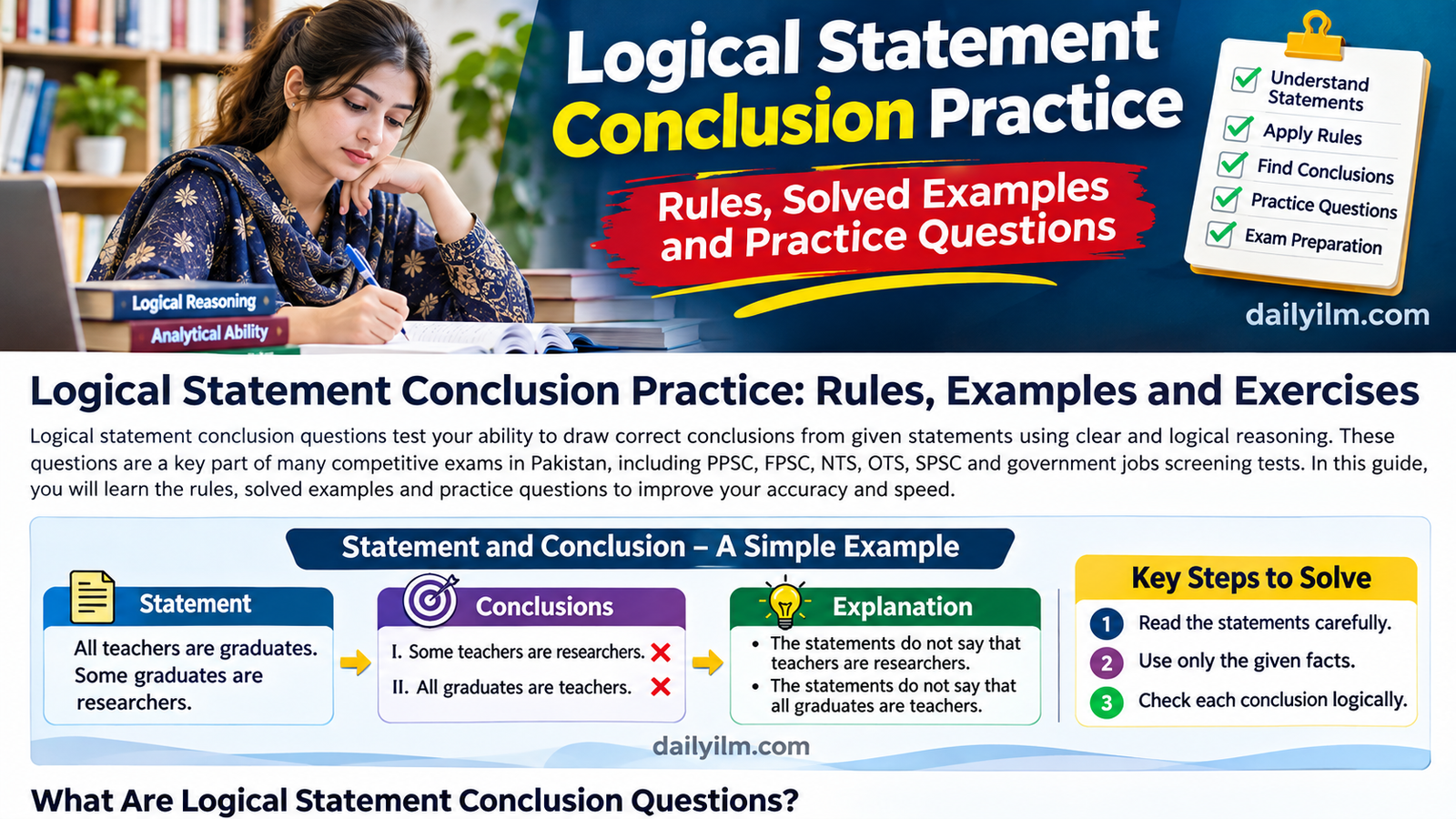
The infographic revisits the first solved example: teachers may be graduates while graduate researchers belong to a different group. Neither proposed conclusion is guaranteed. The image refers to competitive exam preparation generally; consult the current official syllabus to establish whether your specific test includes this question format.
Can You Answer These 20 Original Statement and Conclusion Practice MCQs?
Attempt the following twenty questions without consulting the answer key. Use a notebook to write A, B, C or D for each question. Questions 1–15 practise group relationships and questions 16–20 practise conditional reasoning. Each question is independent: do not carry information from one question into the next.
Answer choices for every question: A. Only conclusion I follows. B. Only conclusion II follows. C. Both conclusions follow. D. Neither conclusion follows.
What Follows in Practice Question 1?
Statements: All laptops are devices. All devices are inventoried items.
Conclusion I: All laptops are inventoried items.
Conclusion II: All inventoried items are laptops.
What Follows in Practice Question 2?
Statements: Some readers are writers. All writers are members.
Conclusion I: Some members are readers.
Conclusion II: Some readers are members.
What Follows in Practice Question 3?
Statements: No cooks are pilots. Some cooks are trainees.
Conclusion I: Some trainees are pilots.
Conclusion II: Some trainees are not pilots.
What Follows in Practice Question 4?
Statements: All buses are vehicles. Some vehicles are electric machines.
Conclusion I: Some buses are electric machines.
Conclusion II: All electric machines are buses.
What Follows in Practice Question 5?
Statements: Some books are gifts. No gifts are damaged items.
Conclusion I: Some books are not damaged items.
Conclusion II: Some damaged items are books.
What Follows in Practice Question 6?
Statements: No clerks are supervisors. All assistants are clerks.
Conclusion I: No assistants are supervisors.
Conclusion II: No supervisors are assistants.
What Follows in Practice Question 7?
Statements: Some folders are blue items. Some folders are heavy items.
Conclusion I: Some blue items are heavy items.
Conclusion II: All blue items are heavy items.
What Follows in Practice Question 8?
Statements: All medals are awards.
Conclusion I: Some awards are medals.
Conclusion II: All medals are awards.
What Follows in Practice Question 9?
Statements: Some employees are not managers. All employees are staff members.
Conclusion I: Some staff members are not managers.
Conclusion II: All staff members are employees.
What Follows in Practice Question 10?
Statements: No triangles are circles. Some shapes are triangles.
Conclusion I: Some shapes are not circles.
Conclusion II: Some triangles are shapes.
What Follows in Practice Question 11?
Statements: All interns are trainees. All assistants are trainees.
Conclusion I: Some interns are assistants.
Conclusion II: No interns are assistants.
What Follows in Practice Question 12?
Statements: Some applicants are graduates. No graduates are untrained people.
Conclusion I: Some applicants are untrained people.
Conclusion II: Some applicants are not untrained people.
What Follows in Practice Question 13?
Statements: Some pens are stationery items. All pens are blue items.
Conclusion I: Some stationery items are blue items.
Conclusion II: All stationery items are blue items.
What Follows in Practice Question 14?
Statements: No visitors are employees. Some visitors are ticket holders.
Conclusion I: No ticket holders are employees.
Conclusion II: Some ticket holders are not employees.
What Follows in Practice Question 15?
Statements: Some flowers are red items. Some red items are decorations.
Conclusion I: Some flowers are decorations.
Conclusion II: All flowers are decorations.
What Follows in Practice Question 16?
Statements: If a switch is activated, then the lamp illuminates. A switch is activated.
Conclusion I: The lamp illuminates.
Conclusion II: It is not true that the lamp illuminates.
What Follows in Practice Question 17?
Statements: If an entry is verified, then a stamp is present. It is not true that a stamp is present.
Conclusion I: An entry is verified.
Conclusion II: It is not true that an entry is verified.
What Follows in Practice Question 18?
Statements: If automatic saving is enabled, then a backup exists. A backup exists.
Conclusion I: Automatic saving is enabled.
Conclusion II: It is not true that automatic saving is enabled.
What Follows in Practice Question 19?
Statements: If the request is approved, then the code is generated. If the code is generated, then the code is recorded. The request is approved.
Conclusion I: The code is generated.
Conclusion II: The code is recorded.
What Follows in Practice Question 20?
Statements: If the alarm is armed, then a signal is transmitted. It is not true that the alarm is armed.
Conclusion I: It is not true that a signal is transmitted.
Conclusion II: A signal is transmitted.
What Are the Correct Answers and Explanations?
Compare your choices with the answer key only after finishing the set. Every answer has been checked under the explicit set or conditional interpretation introduced in this article. Where a conclusion does not follow, it may still be possible; the explanation identifies why it is not necessary.
| Question | Answer | Reason |
|---|---|---|
| 1 | A — Only conclusion I follows | Inclusion passes along the chain. The reverse is not guaranteed. |
| 2 | C — Both conclusions follow | The reader who is a writer must also be a member. Both conclusions express that overlap. |
| 3 | B — Only conclusion II follows | The trainee who is a cook cannot be a pilot. Other trainees may or may not be pilots. |
| 4 | D — Neither conclusion follows | The electric vehicles need not include buses. No premise makes every electric machine a bus. |
| 5 | A — Only conclusion I follows | A book that is a gift cannot be damaged. The status of other books is unknown. |
| 6 | C — Both conclusions follow | Assistants belong to the clerk group, which is separate from supervisors. The two conclusions describe the same exclusion. |
| 7 | D — Neither conclusion follows | The blue folder and the heavy folder could be different objects. No common blue-heavy object is guaranteed. |
| 8 | B — Only conclusion II follows | The universal inclusion is given. It does not establish that a medal exists. |
| 9 | A — Only conclusion I follows | The employee outside the manager group is also a staff member. Other staff may not be employees. |
| 10 | C — Both conclusions follow | The existing triangle is a shape and cannot be a circle. The same overlap can be stated in either order. |
| 11 | D — Neither conclusion follows | Two groups inside the trainee group may overlap or be separate. Neither outcome is forced. |
| 12 | B — Only conclusion II follows | The graduate applicant is not untrained. The other applicants’ status is unknown. |
| 13 | A — Only conclusion I follows | At least one pen is both stationery and blue. Other stationery need not be blue. |
| 14 | B — Only conclusion II follows | The visitor with a ticket is not an employee. That does not exclude every employee from holding a ticket. |
| 15 | D — Neither conclusion follows | Different red objects can satisfy the two premises. No flower-decoration overlap is necessary. |
| 16 | A — Only conclusion I follows | The first condition is established, so its stated consequence follows. |
| 17 | B — Only conclusion II follows | If a verified entry guarantees a stamp and the stamp is absent, the entry is not verified under this rule. |
| 18 | D — Neither conclusion follows | A backup may exist for some other reason. Its existence alone cannot establish whether automatic saving is enabled. |
| 19 | C — Both conclusions follow | P guarantees Q and Q guarantees R, so both consequences must occur. |
| 20 | D — Neither conclusion follows | A missing first condition does not determine the consequence. Both outcomes remain consistent with the rule. |
Give yourself one mark for each correct answer and zero for an incorrect or unanswered question. This is a self-study scoring method, not an official examination marking scheme. Your accuracy percentage equals the number of correct answers divided by 20, multiplied by 100. For example, 16 correct answers equal 80% practice accuracy.
How Can You Interpret Your Practice Score?
| Correct answers | Suggested next step |
|---|---|
| 0–9 | Revisit the meanings of all, some, no and some not. Work through examples without time pressure. |
| 10–14 | Review incorrect answers and identify whether the mistake involves reversed inclusion, existence or conditional logic. |
| 15–17 | Repeat the difficult patterns using fresh examples and gradually introduce a time limit. |
| 18–20 | Try a mixed reasoning set and focus on explaining why every rejected conclusion fails. |
These ranges are editorial study suggestions, not validated diagnostic thresholds, pass marks or predictions of admission-test performance. A low score on one set identifies topics to revisit; it does not establish your overall intelligence or academic ability.
Which Common Mistakes Should You Avoid in Logical Reasoning Tests?
- Reversing all statements: all A are B does not imply all B are A.
- Treating some as some but not all: some means at least one, and does not exclude the possibility that all members qualify.
- Assuming existence without evidence: a universal relationship need not imply that a member exists under the rules used here.
- Joining two unrelated overlaps: two groups may contain different members of a third group.
- Confusing possibility with necessity: a possible conclusion is not necessarily a required one.
- Reversing a conditional: the consequence of a rule may occur for another reason.
When a question explicitly asks whether a conclusion is possible, the task changes: find at least one arrangement consistent with the statements that makes it true. When the question asks whether a conclusion follows, it must be true in all permitted arrangements. Keep the two question types separate.
How Can You Prepare for Reasoning Questions in Pakistani Entry Tests?
Begin with the official test pattern relevant to your application. NTS’s NAT pattern lists analytical reasoning, but its categories and question distributions differ. A university or recruiting body may use its own paper pattern, and not all reasoning sections test the same subtopics.
DailyILM’s GCU Lahore entry test sample paper and pattern guide provides a separate starting point for students interested in that university. Check the institution’s current official instructions before relying on any practice pattern. For younger students who need help organising preparation, our balanced exam practice schedule for children explains how to combine revision, breaks and regular practice.
For this particular topic, begin with ten minutes of reading the rules and ten minutes of untimed practice. On another day, attempt a short mixed set without notes, review every error and rewrite one incorrect inference as a valid one. Introduce timing only after you understand the method; a suggested initial target of one minute per straightforward question is a practice choice, not a universal test limit.
Source note: the deductive reasoning principles in this guide were cross-checked against OpenStax Introduction to Philosophy, section 5.4, and Contemporary Mathematics, section 2.7. The NAT paper-pattern context was checked against National Testing Service Pakistan on 28 November 2026. The examples, questions, answer explanations and scoring guidance are original DailyILM instructional material.
Before selecting your next answer, ask yourself: can I construct a situation in which the statements are true but this conclusion is false? If you can, that conclusion does not necessarily follow.
