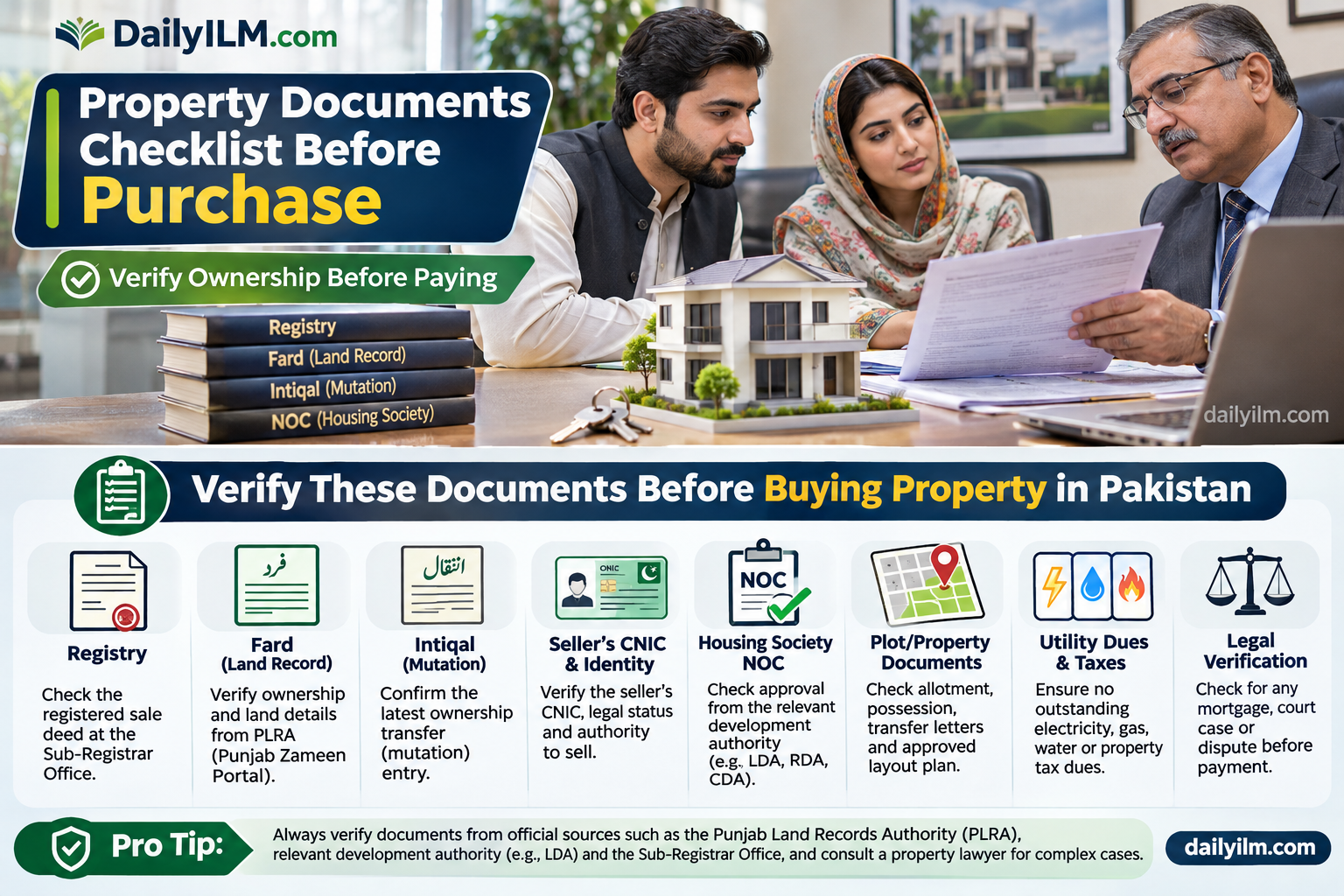
Before buying property in Pakistan, verify the seller’s ownership documents, registered sale deed or other lawful title instrument, latest Fard and Intiqal where applicable, original CNIC, housing scheme approvals, possession records and outstanding dues. Ask the relevant land-record office, development authority or property registrar to confirm the documents independently before paying a substantial deposit.
No single document guarantees that a property is free from disputes, mortgages or competing ownership claims. A genuine Fard may identify a recorded owner, but you still need to establish that the seller has the legal authority to transfer the particular property you intend to buy.
This property documents checklist before purchase applies to buyers of residential houses, plots, apartments and land in Pakistan. The precise documents depend on the province, type of ownership and authority responsible for the property. Punjab’s digital land-record procedure, for example, does not apply automatically to every property in Sindh or Islamabad.
What Is the Property Documents Checklist Before Purchase?
Start by identifying the property and the authority that maintains its records. Then check the following documents against independently obtained information. Some items apply only to particular property types, such as housing scheme allotments or leasehold apartments.
| Document or record | What to verify | Where to confirm |
|---|---|---|
| Registered sale deed or title instrument | Seller’s title, previous transfer and property description | Sub-Registrar or relevant issuing authority |
| Fard-e-Malkiat | Recorded ownership, area, shares and land identifiers | Relevant revenue or land-record office |
| Intiqal (mutation) | Recorded change of ownership and attestation status | Land-record or revenue office |
| Seller’s original CNIC | Identity and consistency with ownership records | Official transfer and identity-verification procedure |
| Housing scheme NOC and approved layout | Approval status of the exact scheme, phase and plot location | Relevant development or planning authority |
| Allotment, transfer or lease documents | Seller’s contractual or ownership rights and transfer restrictions | Society, developer, lessor or allotting authority |
| Possession and site records | Physical location, boundaries, access and occupation | Site inspection and relevant authority |
| Tax, society and utility records | Outstanding charges and responsibility for payment | Revenue, society and utility offices |
| Mortgage, dispute and legal records | Restrictions, court orders and competing claims | Property lawyer, lender and relevant offices |
Keep a dated record of each verification. Note the office that issued the information and the document or reference number. This makes it easier to resolve differences between paperwork supplied by the seller and records held by the relevant authority.
Which Documents Establish Property Ownership in Pakistan?
The correct starting point is the seller’s chain of title. This means the documents showing how the property passed from earlier owners to the current seller. Depending on the property, the chain may include registered sale deeds, gift documents, inheritance records, allotments, leases or other lawful transfer instruments.
Section 54 of the Transfer of Property Act, 1882 distinguishes a completed sale from a contract to sell. An agreement to sell, by itself, does not create an ownership interest or charge over the property. The Registration Act, 1908 also governs the registration and legal effect of documents that require registration. Applicable provincial amendments and special land or lease regimes can affect the procedure.
For an ordinary purchase of privately owned land or a house, ask a lawyer to examine the relevant registered conveyance and earlier title documents. For a leasehold property, find out who owns the underlying land, how long the lease remains valid and whether the lessor must consent to the transaction.
A receipt for a booking payment, an electricity bill or a photocopy of an old deed does not replace the applicable title and transfer documents.
What Is the Difference Between Fard, Registry and Intiqal?
Buyers often use these terms interchangeably, although they describe different records. The Punjab Land Records Authority (PLRA) provides separate services for Fard issuance, deed registration and mutation processing.
| Term | Purpose | Important limitation |
|---|---|---|
| Fard | Extract from the relevant land records showing recorded particulars and ownership information | Does not establish that every competing claim or restriction is absent |
| Registry | Registered deed recording the relevant transaction or conveyance | Registration does not cure defects in the seller’s underlying title |
| Intiqal | Entry recording a change in revenue records following a transaction, inheritance or another event | A mutation entry alone does not replace the legal basis of the transfer |
| Agreement to sell (Bayana) | Records the agreed terms of a proposed sale and any advance payment | Does not by itself transfer title |
| Society allotment or transfer letter | Records an allotment or transfer within a housing scheme | Rights depend on the underlying title, rules and approvals |
Suppose a seller presents a registered deed but the latest land record still identifies an earlier owner. Do not assume either document is false, and do not assume the difference is harmless. Ask the relevant office to explain the discrepancy and have the necessary ownership updates or legal corrections completed before the transaction proceeds.
How Can You Verify Property Ownership Online in Punjab?
In Punjab, the Punjab Land Records Authority operates digital land-record services and Arazi Record Centres (ARCs). Its official online services include document verification for Fard and Intiqal. The service you need depends on whether the particular land or property falls within the relevant record system.
Obtain the full property particulars from the seller, including district, tehsil, mauza, area and the relevant khewat or khasra numbers. Check these details against a current record obtained through PLRA or the competent revenue office. Use the official document-verification facility when the record carries an eligible verification reference.
Compare the registered deed number and property description with the registry record. Ask whether the relevant mutation has been entered and attested. If the seller provides an old Fard or a screenshot from an unofficial website, obtain a fresh official record rather than rely on the copy.
PLRA also describes a Green Property Certificate service for verification of property status and ownership. For property within housing schemes in Lahore, the Lahore Development Authority’s website carries a public notice concerning property certificates. Confirm the current certificate requirement and its application to your specific scheme and transaction with LDA and PLRA before proceeding.
Digital access does not eliminate every need for an office visit. Incomplete records, recent transfers and differences in names or land descriptions may require further examination or an official correction.
Where Should You Verify Property Documents Outside Punjab?
Land administration and property approval systems differ across Pakistan. Do not enter a Sindh property into Punjab’s land-record portal and expect a complete ownership history.
| Location | Relevant starting point |
|---|---|
| Punjab | PLRA, relevant revenue office, Sub-Registrar and local development authority |
| Sindh | Board of Revenue Sindh, Sindh Zameen services and the relevant registry or allotting authority |
| Islamabad | Capital Development Authority (CDA), relevant revenue and registration offices, or other competent title authority |
| Khyber Pakhtunkhwa and Balochistan | Provincial revenue authorities, relevant local land-record offices and registration authorities |
| Special, cantonment or leasehold properties | The competent allotting, leasing, estate or development authority |
The Board of Revenue Sindh offers an official digital land-record portal. Its online information carries a legal disclaimer, so obtain the appropriate official or certified record and have it reviewed before relying on it for a purchase.
How Can You Verify the Seller’s Legal Identity?
Ask the seller to produce the original Computerised National Identity Card (CNIC) and compare the identity details with the official ownership documents. Complete any biometric or identity checks that the relevant registration or transfer authority requires.
If several individuals own the property, determine the share each person owns and whose consent or participation the transfer requires. A person who owns one share cannot automatically sell the entire property as if the other owners have no rights.
When a representative claims authority through a power of attorney, ask a property lawyer to examine its authenticity, scope, validity, revocation status and applicable registration or authentication requirements. Verify that the authority covers the particular sale. Where possible, confirm the arrangement independently with the actual owner.
Inherited property deserves extra care. Check the lawful succession documents, recorded ownership changes and rights of all relevant heirs. Do not rely on a statement that family members have agreed informally to the sale.
How Can You Check Whether a Housing Society Is Approved?
Check the current official approval status with the authority responsible for planning and development in the area. In Lahore, LDA publishes information on approved, regular and illegal schemes. For Islamabad, CDA lists housing schemes and distinguishes between layout plan approval and the issuance of a development NOC.
This distinction matters. CDA describes a two-stage approval procedure for private schemes: approval of the layout plan followed by issuance of a development NOC after the necessary formalities. A developer advertising a layout approval does not necessarily have a development NOC.
Check the exact name, phase, extension and sector rather than the name of the developer alone. Confirm that the specific plot appears within the approved layout and ask the authority about any cancellation, suspension or other restrictions.
A society NOC does not prove that a particular seller owns a particular plot. Verify the individual allotment or title separately.
Which Documents Should You Check Before Buying a Plot?
For a developed residential plot, compare the allotment or transfer letter, plot number, block, area, approved layout plan and possession status with the society’s official records. Ask whether the society permits the transfer and whether it requires a no-demand certificate or other clearance.
Visit the site before committing. Confirm that the plot exists at the location described, that its boundaries match the records and that access is available. For land identified by revenue survey numbers, consider official demarcation or a professional survey where the boundaries are uncertain.
A plot file may represent an allotment, contractual entitlement or proposed future plot rather than a physically demarcated property. If someone offers an unballoted file as a ready-to-build plot, ask the issuing authority what rights the file actually confers.
Which Additional Documents Are Needed When Buying a House or Apartment?
Buying a constructed property requires checks beyond land ownership. Ask for the sanctioned building plan and any completion or occupancy documentation the competent authority requires for that type of building. Compare the approved plan with the actual construction. Unauthorised additions, changes in use or building violations can create difficulties later.
For apartments, also examine the developer’s title or lease, the agreement governing your unit, the building’s relevant approvals and any restrictions on transfers. Check whether parking, common areas and maintenance charges match the agreement. In Karachi and other areas under its jurisdiction, the Sindh Building Control Authority publishes information about approved building plans and public-sale project NOCs.
Verify the electricity, gas, water and property-tax accounts, where applicable. Do not assume the seller’s latest paid electricity bill clears earlier arrears or society maintenance charges. Ask the responsible service providers and management office for the outstanding balances.
For a property served by HAZECO, our HAZECO online bill check guide explains how to obtain the bill for that service area. If a newly acquired house requires a separate electricity connection rather than a change to an existing account, consult our ENC new electricity connection guide to understand the application process. Utility documents support service arrangements; they do not establish legal title.
How Can You Identify Mortgaged or Disputed Property?
Ask the seller to disclose any mortgage, loan, charge, tenancy, litigation or restrictions affecting the property. Arrange an independent legal examination of relevant registration records, title papers and available court or authority records. A clean online ownership entry cannot rule out every private claim, mortgage or legal dispute.
Where a lender holds the original title documents, request written confirmation of the outstanding loan and the procedure for releasing the security. A lawyer should structure any payment to the lender and ensure that the release or discharge takes effect under the applicable rules. Do not give the seller the full price simply on a promise that the loan will be cleared afterwards.
Check who actually occupies the house or plot. If a tenant or another person occupies it, establish the terms of their occupation and when lawful vacant possession can take place. Ownership and physical possession are separate issues.
What Should You Verify Before Paying Token Money?
Complete initial ownership and approval checks before agreeing to any substantial advance. A seller or dealer who demands immediate payment before showing original documents creates a risk that the buyer can avoid.
Before signing an agreement to sell, ask your lawyer to review the parties’ details, exact property description, agreed price, amount paid, completion deadline, allocation of taxes and fees, conditions for clearance of title, and consequences if the transaction cannot proceed. Document any refund conditions clearly.
For example, if the seller offers a house for Rs. 10 million and asks for Rs. 500,000 as token money, the size of that advance does not prove ownership or approval. An agreement should address what happens to the advance if the seller cannot establish a transferable title. These figures are illustrative, not standard legal deposit amounts.
Use a traceable payment method and obtain a signed receipt identifying the transaction. Never sign a blank form, leave key terms unstated or agree to misrepresent the consideration on official documents.
How Can You Confirm the Taxes and Transfer Costs?
Calculate the full acquisition cost before committing. Depending on the transaction, this may include provincial stamp duty, registration charges, mutation charges, society transfer fees, applicable federal advance income tax and other government or professional expenses.
The Federal Board of Revenue provides withholding tax rate cards and guidance on property transactions, including sections 236C and 236K of the Income Tax Ordinance, 2001. The applicable treatment depends on the current law and the circumstances of the buyer and seller. Punjab also operates an e-stamping system through PLRA for relevant instruments.
Request a current itemised calculation from the competent authority or a qualified tax adviser. Confirm who bears each cost under the sale agreement, and retain official payment receipts. This guide does not quote fixed percentages because tax rates, valuation rules and administrative charges may change.
Which Documents Should You Collect After Buying Property?
After completion, obtain the applicable executed and registered deed or official transfer instrument, the relevant updated land record or mutation confirmation, society or authority transfer documents where applicable, and receipts for the purchase price, taxes and fees. Keep written possession records and any lender release documents relevant to the transaction.
Confirm directly with the responsible office that the ownership or transfer record reflects the completed transaction. If an official update remains pending, track its status and keep the acknowledgement. Do not treat payment of the full purchase price as the end of the administrative process.
Arrange utility account changes separately and retain a copy of the final meter readings or account clearances where available. Store the original property papers securely and maintain a separate digital backup.
When Should You Consult a Property Lawyer?
Independent legal review is particularly important when the seller acts through a representative, the property has passed through inheritance, the original title documents are unavailable, the boundaries are unclear, a mortgage remains outstanding or the authority records do not match the seller’s documents. For leasehold property and under-construction projects, a lawyer can help identify the rights and restrictions that the relevant instruments create.
This guide provides general information rather than a legal opinion on a particular property. The exact documents and transfer procedure depend on applicable law and the property authority. An independent lawyer should examine the complete title and transaction before you commit a substantial amount of money.
Official sources consulted for this guide include Pakistan Code, the Punjab Land Records Authority, Lahore Development Authority, Capital Development Authority, Board of Revenue Sindh, Sindh Building Control Authority and Federal Board of Revenue. The document-verification services and official guidance were checked on 28 November 2026.
Before making your next payment, can you independently confirm the seller’s title, the property’s exact identity and the legal procedure that will transfer those rights to you?