A reasonable exam practice schedule for children combines short, focused study sessions, regular revision, practice questions, physical activity and sufficient sleep. As a flexible starting point, primary school children may benefit from 15 to 60 minutes of daily revision, while older students may manage 60 to 120 minutes, depending on their academic workload and individual learning needs.
The purpose of an examination timetable is to help children understand and remember their lessons without becoming physically tired or emotionally overwhelmed. Parents should consider school hours, homework, tuition classes, meals and recreational activities before assigning additional study time.
Research from the Australian Education Research Organisation (AERO) supports distributing learning across multiple sessions and encouraging students to recall previously learned information. This approach helps develop long-term understanding rather than depending entirely on last-minute memorisation.
What Is a Reasonable Exam Practice Schedule for Children?
A reasonable exam practice schedule is a realistic daily and weekly learning plan that allows children to prepare for examinations while maintaining healthy routines.
An effective timetable should focus on completing meaningful learning tasks rather than spending a fixed number of hours sitting with textbooks.
For example, solving five mathematics questions independently and correcting mistakes may be more useful than spending an hour repeatedly reading a mathematics chapter.
Parents should consider five important factors when preparing an examination timetable:
- The child’s age, concentration and learning abilities.
- The number of subjects and chapters included in the examination.
- Existing schoolwork, homework and tuition commitments.
- The time remaining before examinations.
- Adequate opportunities for sleep, exercise and relaxation.
Children who understand their lessons may need less revision than those experiencing difficulties with particular subjects. The timetable should reflect these differences instead of applying the same study requirements to every child.
How Long Should Children Study for Exams at Different Ages?
There is no universally established number of study hours that guarantees examination success for every child. Study requirements vary according to age, academic level, subject difficulty, previous preparation and individual circumstances.
Parents can use the following suggested durations as starting points.
| Age group | Individual study session | Suggested break | Example daily revision |
|---|---|---|---|
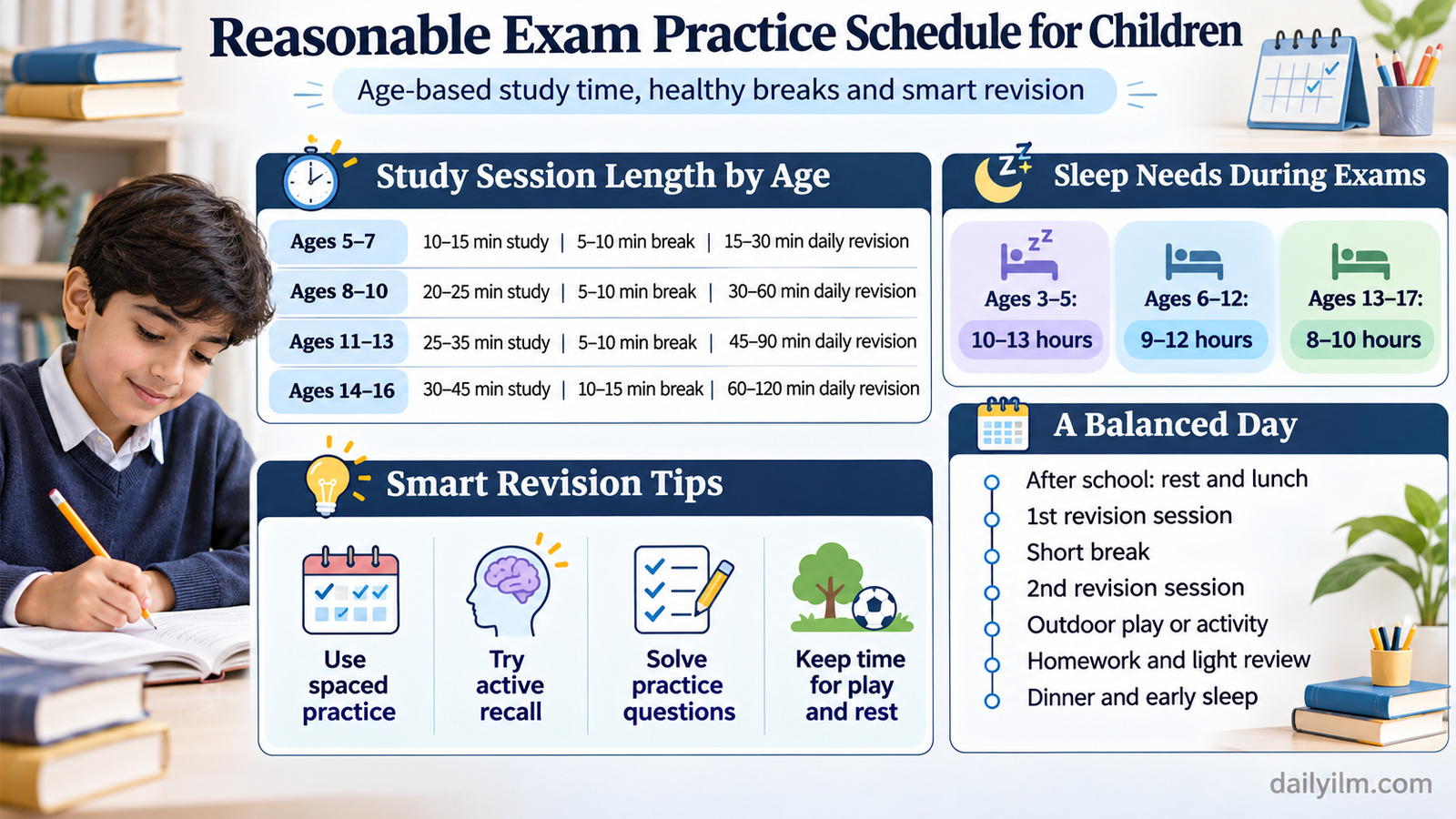
| 5–7 years | 10–15 minutes | 5–10 minutes | 15–30 minutes |
| 8–10 years | 20–25 minutes | 5–10 minutes | 30–60 minutes |
| 11–13 years | 25–35 minutes | 5–10 minutes | 45–90 minutes |
| 14–16 years | 30–45 minutes | 10–15 minutes | 60–120 minutes |
These durations are illustrative planning suggestions, not official educational requirements or medically established attention limits. Daily revision time excludes breaks but should account for overlapping homework and tuition activities.
A child who has already completed substantial academic practice at school or in tuition may require considerably less additional revision at home.
Parents should shorten study sessions if children repeatedly lose concentration, become unusually frustrated or struggle to understand material they previously understood.
How Can Parents Create a Daily Exam Preparation Timetable?
A practical examination preparation timetable should fit the family’s existing routine.
In Pakistan, many students attend school in the morning and return home during the afternoon. Some also attend tuition centres, participate in religious education or help with household responsibilities.
Adding several hours of compulsory study to an already demanding day can leave children with insufficient time to recover.
The following example illustrates an after-school routine for a student aged approximately 11 to 13 years.
| Time | Activity |
|---|---|
| 2:00–3:00 PM | Lunch and rest after school |
| 3:00–3:30 PM | Mathematics revision |
| 3:30–3:40 PM | Short break |
| 3:40–4:10 PM | English, Urdu or Science revision |
| 4:10–5:00 PM | Outdoor play or physical activity |
| 5:00–5:30 PM | Homework or unfinished school tasks |
| 5:30–7:30 PM | Personal, family and religious activities |
| 7:30–8:00 PM | Dinner |
| 8:00–8:15 PM | Recall important lessons and prepare school materials |
| After 8:15 PM | Relaxation and preparation for bedtime |
This routine provides 75 minutes of focused revision alongside a separate homework period.
Families should adjust the timing according to school schedules, commuting, prayer times, tuition arrangements and bedtime requirements. A child attending tuition during the afternoon can replace one or both revision sessions with appropriate tuition work instead of repeating the same tasks.
The timetable should support learning, not become another source of pressure.
What Does a Balanced Weekly Revision Schedule Look Like?
A weekly revision timetable helps children cover different subjects while returning to previously studied material.
Instead of completing an entire subject in a single day, students can revisit important topics several times throughout the week.
The following example suits a middle-school student preparing for examinations in Mathematics, English, Urdu, Science, Islamiat and Social Studies.
| Day | First session | Second session |
|---|---|---|
| Monday | Mathematics | English |
| Tuesday | Science | Urdu |
| Wednesday | Mathematics | Islamiat |
| Thursday | English | Social Studies |
| Friday | Science | Review difficult topics |
| Saturday | Practice questions | Review and correct mistakes |
| Sunday | Light revision | Rest and family activities |
Parents should adapt this timetable to the child’s actual subjects and examination date sheet.
For example, if Mathematics is the first examination and the child struggles with fractions, the weekly timetable can include additional short sessions on fractions while maintaining progress in other subjects.
Sunday does not have to become another full academic day. When children have completed their learning targets, they can use the day primarily for recreation and family activities.
How Should Primary School Children Prepare for Exams?
Primary school children generally need more guidance when organising their learning activities.
Parents can begin by reviewing the examination syllabus provided by the school and identifying small, manageable tasks. A young child may find the instruction to revise an entire textbook confusing, while a specific request to practise five spellings or solve four addition questions provides a clear objective.
For Mathematics, children can practise counting, calculations and simple word problems. Parents can use everyday objects, such as pencils, coins or fruit, to demonstrate concepts.
English and Urdu revision can include reading aloud, practising spellings, explaining short passages and writing simple sentences.
For General Knowledge and Science, pictures, diagrams and short conversations can help children explain concepts in their own words.
Parents should avoid turning every revision activity into a formal examination. Informal questions and short educational games provide opportunities to identify learning difficulties without unnecessary pressure.
When a child struggles with a task, explain the concept again before expecting an independent answer.
How Should Middle and Secondary School Students Revise?
Students in middle and secondary school can gradually take greater responsibility for their examination preparation.
They should begin with the syllabus, available study materials and examination schedule. Dividing each subject into smaller topics makes it easier to identify what requires further attention.
Students preparing for Class 9 and Class 10 examinations in Pakistan should follow their relevant Board of Intermediate and Secondary Education (BISE) syllabus, prescribed textbooks and officially available examination guidance.
Where a board provides model papers, students can use them to understand question formats and practise written answers.
Mathematics preparation should include solving numerical problems independently. Science revision can include explanations, diagrams, definitions and calculations. Language subjects require attention to comprehension, grammar and written expression.
Students can maintain a separate notebook for mistakes discovered during practice. Recording the correct method alongside an incorrect answer creates a useful resource for subsequent revision.
Older students may gradually introduce timed practice papers. However, they should first understand the underlying material. Repeatedly attempting papers without correcting learning gaps can leave important concepts unresolved.
Which Revision Techniques Help Children Remember More?
Effective examination preparation depends on how children study, not simply how long they study.
Educational research supports several approaches that parents and students can incorporate into a home revision timetable.
How Does Spaced Practice Improve Learning?
Spaced practice means revisiting a topic across several study sessions instead of concentrating all revision into one sitting.
For example, a student learning fractions can study the basic method on Monday, solve additional questions on Wednesday and revisit difficult problems on Saturday.
AERO identifies spaced learning as an effective approach to supporting long-term retention.
Parents do not need a complicated revision application. A simple notebook or weekly calendar can help them record when children should revisit previously studied topics.
How Does Active Recall Help During Exam Preparation?
Active recall, also called retrieval practice, involves trying to remember information without immediately consulting notes or textbooks.
After reading a Science lesson, a child can close the book and explain the main concept. A Mathematics student can attempt a problem before looking at the worked example.
Once the child has attempted an answer, they should check it and correct any misunderstanding.
AERO’s guidance explains that retrieval practice supports learning while helping students identify gaps in their knowledge.
How Can Children Use Practice Questions Effectively?
Practice questions help students assess their understanding and become familiar with different ways of presenting answers.
A student who correctly defines evaporation should also try explaining why wet clothes dry in sunlight. Applying knowledge to a familiar situation helps reveal whether the student understands the concept beyond its textbook definition.
Parents should treat incorrect practice answers as opportunities to improve preparation rather than reasons for punishment.
How Often Should Children Take Study Breaks?
Children should take breaks at intervals that suit their concentration and the difficulty of the subject.
A younger child might study for 15 minutes before taking a short break. An older student might complete a 30-minute revision session followed by 5 to 10 minutes of rest.
These intervals are flexible. Some students need shorter sessions, while others can concentrate comfortably for longer periods.
During breaks, children can drink water, stretch, walk around, have a healthy snack or spend a few minutes outdoors.
The NHS recommends encouraging physical activity during examinations as a way of supporting children’s energy levels and managing stress.
Parents should also distinguish between a short revision break and a prolonged period of entertainment. If mobile games or social media regularly interrupt the next session, another activity may provide a more practical break.
How Much Sleep Do Children Need During Exam Preparation?
Children should maintain sufficient sleep throughout the examination period instead of sacrificing rest to complete additional revision.
According to the CDC, recommended daily sleep duration varies by age.
| Age | Recommended sleep per 24 hours |
|---|---|
| 3–5 years | 10–13 hours, including naps |
| 6–12 years | 9–12 hours |
| 13–17 years | 8–10 hours |
Sufficient sleep supports attention and memory, both of which matter during examinations.
Parents can calculate a suitable bedtime using the time their child needs to wake up for school. They should also allow time for children to relax before going to bed.
The evening before an examination is better suited to light revision, organising school materials and resting than attempting to learn several unfamiliar chapters overnight.
How Can Parents Prepare Children for Exams Without Pressure?
Parents play an important role in creating a home environment where children can study comfortably and ask questions without fear.
Setting clear expectations is reasonable, but those expectations should reflect the child’s individual abilities and circumstances.
Comparing children with classmates, siblings or relatives can create unnecessary pressure. Instead, parents can recognise improvements such as completing homework independently, understanding a difficult chapter or correcting repeated spelling mistakes.
Children should also have access to a suitable study space. An expensive desk or separate study room is not essential. A comfortable place with adequate lighting and manageable distractions can serve the same purpose.
The NHS advises parents to listen to children’s concerns, provide encouragement and avoid adding unnecessary pressure during examinations.
If a child regularly struggles with a particular subject, parents can discuss the problem with the teacher. Additional explanation or targeted support may address the difficulty more effectively than simply increasing study hours.
What Should Children Do During the Final Seven Days Before Exams?
The final week before examinations should focus on strengthening existing knowledge, resolving important difficulties and becoming familiar with examination requirements.
Students who begin preparation earlier can use this period to identify gaps rather than attempt to memorise an entire syllabus at the last moment.
| Days remaining | Suggested preparation |
|---|---|
| 7 days | Review the syllabus and identify unfinished topics |
| 6 days | Work on the most difficult concepts |
| 5 days | Practise numerical and written questions |
| 4 days | Revisit previously studied topics |
| 3 days | Attempt suitable practice questions or model papers |
| 2 days | Correct mistakes and review important concepts |
| 1 day | Complete light revision and prepare examination materials |
| Exam day | Eat breakfast, arrive on time and read instructions carefully |
This schedule assumes that the student has already completed most of the syllabus. If several chapters remain unfinished, parents and teachers should help identify essential topics and realistic priorities.
Young children do not need lengthy mock examinations every day. Older students may benefit from timed practice where it matches the actual examination format.
After each examination, students should move their attention to the next subject instead of spending excessive time discussing mistakes they can no longer change.
What Mistakes Should Parents Avoid During Exam Preparation?
A study timetable becomes less useful when it places more importance on hours completed than knowledge gained.
Parents should avoid these common mistakes:
- Assigning long study sessions without considering the child’s age.
- Removing all recreational activities until examinations finish.
- Depending entirely on guess papers or memorised answers.
- Ignoring repeated mistakes and difficulties with basic concepts.
- Encouraging late-night study at the expense of sleep.
- Using punishment, criticism or comparisons to demand higher marks.
Another mistake is creating a timetable that leaves no room for unexpected events. Illness, family commitments, school activities and changes to tuition schedules can interrupt even a carefully planned routine.
A flexible timetable allows children to resume preparation without having to compensate through excessive study the following day.
When Should Parents Reduce Their Child’s Study Workload?
Parents should review the examination preparation schedule when children experience persistent fatigue, difficulty sleeping, frequent headaches, stomach discomfort, irritability or unusual anxiety.
The NHS identifies several of these symptoms as possible signs of examination stress. They can also have other causes, so parents should not automatically assume that every physical symptom results from studying.
Reducing unnecessary workload, introducing more rest and discussing the child’s concerns may help identify what is making preparation difficult.
Children with learning differences, disabilities, health conditions or attention difficulties may require individual adjustments. Parents can coordinate with teachers and appropriate professionals to develop a more suitable learning routine.
If anxiety, low mood or physical symptoms persist, become severe or interfere with everyday activities, parents should consult a qualified healthcare professional.
The most effective examination timetable is one that children can follow consistently while remaining healthy, confident and willing to learn. Academic preparation matters, but children also need enough time to sleep, play, communicate with their families and develop interests outside the classroom.
Before increasing your child’s study hours, ask one practical question: is your child developing a better understanding of the subject, or simply spending more time with the books?